You have probably heard the term "sound healing" or seen videos of people striking small metal forks and holding them near their body. What is actually happening, and more importantly, can you use tuning forks in your own home without years of training?
The answer is yes. Tuning forks are one of the most accessible sound tools because they require almost no skill to produce, feel and benefit from. This guide will give you the basics – what they are, the most useful frequencies for beginners, simple ways to use them, and three rituals you can start with tonight. No woo-woo, no overwhelm, just practical steps so you can decide for yourself.
What Is a Healing Tuning Fork (And Why Does It Work?)
A tuning fork is a two-pronged metal instrument that vibrates at a precise, consistent frequency when struck. Unlike singing bowls or gongs that rely on resonance and harmonics, tuning forks produce a clean, single-tone vibration that you can feel as well as hear.
The "healing" part comes from how your body responds to those vibrations. When a fork is activated and held near you, the sound waves create tiny pressure changes in the air and gentle vibrations that travel through your tissues. This is called entrainment: your body’s own rhythms (breath, heartbeat, nervous system) gently synchronise to the frequency you are offering.
It is not magic. It is physics. Your cells, organs and even brainwaves naturally respond to vibration – they have been doing it since you were in the womb, listening to your mother’s heartbeat. Tuning forks simply give you a tool to offer your body a clear, steady signal.
The Most Useful Frequencies for Beginners
Tuning forks are labelled with their frequency in Hertz (Hz), which is how many times per second they vibrate. You do not need to understand the math; you just need to know a few frequencies that people commonly use and what they tend to feel like.
Here are four beginner-friendly ones:
128 Hz (The "All-Purpose" Fork)
- Deep, grounding tone.
- Feels like a gentle reset for the body, especially after travel, stress or feeling scattered.
- Perfect first fork because it is low and easy to hear.
256 Hz (The "Stress Relief" Fork)
- Slightly higher, clearer tone.
- Calms the nervous system, quiets mental chatter, supports focus.
- Many people use it over the forehead or heart for anxiety.
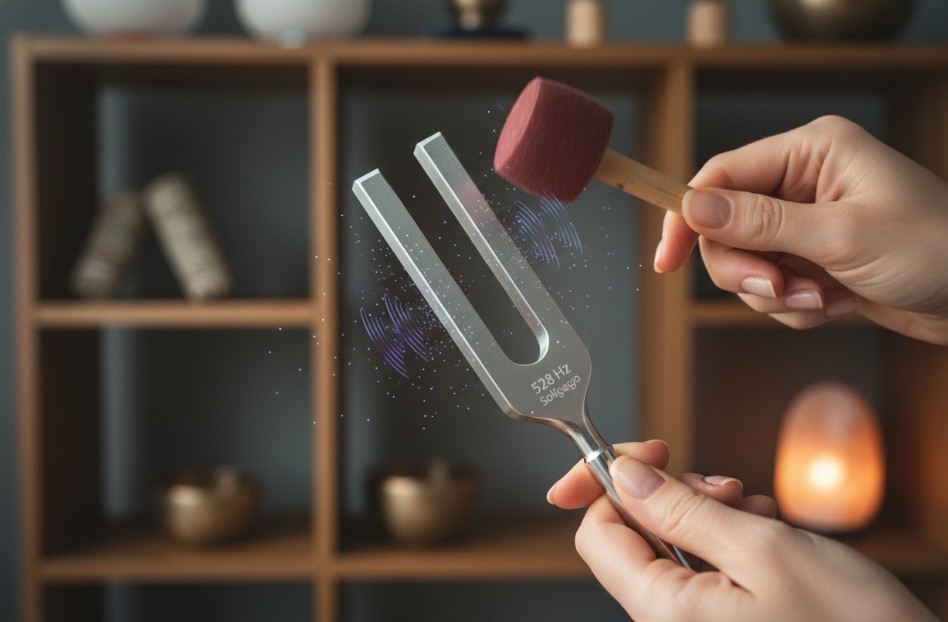
528 Hz (The "Love Frequency")
- Mid-range, warm tone.
- Associated with heart opening, DNA repair and regeneration (in the energetic sense).
- Feels uplifting without being jarring.
136.1 Hz (The "Om" Fork)
- Very low, almost humming tone.
- Matches the Earth’s natural resonance (Schumann resonance).
- Deeply grounding, excellent for meditation or sleep.
Start with one or two. A simple set with 128 Hz and 256 Hz covers most daily needs. As you get comfortable, you can add others.
How to Use a Tuning Fork: The Basic Technique
Using a tuning fork is simple. You need:
- Your fork.
- A soft striker (rubber or silicone mallet).
- A quiet moment (2–5 minutes).
- Optional: a small velvet pouch or stand.
The Four Steps:
1. Activate
Hold the fork by the stem (the handle part). Tap the side of the two prongs firmly but gently with your striker. You should hear a clear tone and see the tines (prongs) moving apart and together. If the sound dies immediately, tap harder next time.
2. Feel
Hold the vibrating fork 1–3 inches from your skin (do not touch unless specified). Notice the sound waves as gentle pressure, like a soft breeze.
3. Place
Move the fork slowly over the area you want to work with (heart, forehead, solar plexus, tense shoulders). Let your intuition guide you; there is no wrong way.
4. Listen
Let the sound fade naturally. Take a few breaths. Notice any shifts in your body, breath or mood.
That is it. No special posture, no chanting, no crystals required (though you can add them if they feel right).
Three First Rituals to Try Tonight
Rituals give structure to the practice so it sticks. Here are three simple ones that take 2–5 minutes each.
Ritual 1: Morning Nervous System Reset (128 Hz or 256 Hz)
When: First thing upon waking, before coffee or phone.
Why: Clears overnight tension and sets a steady tone for the day.
- Sit up in bed or on a chair.
- Activate your fork.
- Hold it near your forehead for 30 seconds (eyebrows to crown).
- Move slowly to your heart for 30 seconds.
- End with three slow breaths, feeling the vibration settle.
Most people notice their mind feels less scattered and their body more "here" after this.
Ritual 2: Midday Stress Release (256 Hz)
When: Lunch break, between meetings, or when you feel wired but stuck.
Why: Quickly down-regulates the nervous system without caffeine or scrolling.
- Find a quiet spot (bathroom stall works in a pinch).
- Activate fork.
- Circle slowly around your ears and jaw for 20 seconds each side (releases tension held there).
- Hold at heart level while taking five slow exhales.
- Tap the fork on a soft surface to stop the sound.
This one is portable and fast. Many people keep a fork in their desk or bag for exactly this.
Ritual 3: Evening Wind-Down (128 Hz or 136.1 Hz)
When: 30 minutes before bed, after brushing teeth.
Why: Signals the body it is safe to let go of the day.
- Sit or lie on your bed.
- Activate fork.
- Trace slowly from the base of your spine up to the back of your head (30 seconds).
- Hold near your feet for 30 seconds (grounding).
- Let the sound fade while you notice your breath slowing.
Pair with dim lights and your favourite natural bedding for maximum effect.
Which Tuning Fork Set Should You Buy First?
Do not overthink this. Here is a simple decision tree:
If You Want One Fork:
Get the 128 Hz. It is versatile, grounding and beginner-friendly.
If You Want a Starter Set (Recommended):
- 128 Hz + 256 Hz (stress, grounding, daily use).
- Add 528 Hz later if you want something more uplifting.
What to Look For:
- Aluminium forks (light, clear tone, long-lasting).
- Weighted forks for beginners (bigger vibration, easier to feel).
- Comes with striker and pouch.
- Reputable brands with accurate tuning (avoid cheap unlabelled sets).
Budget $40–80 for a good starter. Avoid plastic or overly decorative ones; focus on clean tone and quality metal.
Common Beginner Questions (And Straight Answers)
Do I need training?
No. Anyone can use a tuning fork safely. Trust your intuition about where to hold it.
Can I hurt myself?
No. The vibrations are gentle. Avoid pressing hard against the skin or using on open wounds.
How often?
2–3 times a day for 2–5 minutes is plenty. Consistency matters more than duration.
What if I do not "feel" anything?
Totally normal. Some people hear and feel immediately; others notice subtler shifts over days (better sleep, less tension). Keep going for a week.
Kids or pets?
Yes, very safe. Children often love the sound; pets may come closer or relax.
Storage?
Keep in the pouch, away from electronics and strong smells.
Tuning Forks in a Bigger Picture: Sleep, Metals and Textiles
Tuning forks pair beautifully with other natural practices you may already do:
- Use over copper or silver water vessels to "charge" your morning drink.
- Pair with hemp/linen bedding for evening rituals (the natural fibres enhance the grounding).
- Combine with breathwork: inhale as you activate, exhale as you place the fork.
Think of forks as a bridge between "doing" practices (breath, movement) and "being" practices (meditation, rest). They give your body something clear and physical to respond to.
Start Your Sound Healing Practice Today
Tuning forks are not about becoming an expert sound healer overnight. They are about giving yourself a simple, repeatable way to offer your body a clear signal: "Reset. Calm. Ground. Open."
Start with one fork and one ritual. Notice what your body tells you after a week. Let that guide whether you add more frequencies or tools.
The best part? This practice costs less than a month of coffee and takes less time than scrolling. In a world that constantly pulls your attention outward, tuning forks quietly bring you home.
Ready to begin? Full how-to guides and beginner starter sets are waiting for you at earthlyessential.com. Get your first fork and start with confidence today.